Just read this on the net and found it inspiring:
"I spend more of my ‘writing’ time encouraging and motivating other people to write, than actually writing myself. But that is okay … that is wonderfully okay … because in turn, their joy inspires and feeds my writing. When I see others achieve, it excites me, and then, all of a sudden, (usually), whilst I’m travelling, whether in a vehicle or on foot, I’ll read something sad; hear a funny line, see something to make my mouth gape, and I’ll jot it down with whichever pen, eyeliner, mind marker comes first. It germinates and blossoms, and all on its own, turns itself into – some kind of writing."
By Kadija George from Sierra Leone.
Showing posts with label Writing. Show all posts
Showing posts with label Writing. Show all posts
Tuesday, 29 June 2010


Sunday, 7 December 2008
LOUISA LE MARCHAND
AN INTERVIEW WITH GREENWICH BASED WRITER, MUSICIAN AND MULTIPLE ARTIST...
When Self Publishing Becomes the Best Alternative...
I have known Louisa for over a decade;one of those unique and self-motivated innovators; an unsung woman of the hour. She is out there in rain, mist or sun working... never waiting. She might stumble, fall or slip; and others might point fingers and say she is not doing it right; but she always gets up, keeps things going; always with others, rarely alone, in the community, never selfish...

Louisa works regularly in schools...
As I write this I am thinking of some of the many talented and original artists like T.S. Elliot and Charlie Chaplinwho had to run their own things before being widely recognised. I have just finished reading "Whispers in the Mists of Time" by this Greenwich based lady who has the kindest heart and most creative mind. My conclusion? If you are looking for a simple but dear Christmas present (of quality) in these dire times, order a copy of this remarkable book.
Details at the end of this interview...

THE INTERVIEW...
Q.It is impossible to pin down a multi-talented person like you. How would you describe your abilities in a brief conversation?
LLM
I always say I am an artist, I suppose a multi-media artist might explain it. You know yourself (you’re the same); you just find different ways of expressing the spark of art that drives you. But my core, my essence I feel is the poetry, (although I love performing) when I write there is no one else, I feel connected to something greater than myself its very powerful, very exhilarating.

Louisa blowing her way in a story telling performance at the National History Museum, London, 2006. The piece takes you across different cultures.
Q.
A multi-skilled friend of mine says when he is doing one of his activities he just concentrates on the given task. Next time they see him doing something else he loves seeing the surprise on their faces. Do you identify with that?
LLM
Not really if anyone asks me what I am doing I will tell them, but I suppose there are always lots of other creative things floating around, on the back burner so to speak, which I dip into and suddenly will surface. I also have a business persona that I adopt to take care of the business side of things; she would probably fit well in the poem Debating with Myself, but it helps to put on a business hat to become a different character as I also love to act as well as sing.
(A line from “Debating with Myself” :
“THE PSYCHOANALYSTS HAVE ANALYSED AND THE PSYCHIATRISTS HAVE LEFT
SO NOW TO KEEP A BALANCE I GROW OAK TREES AND LISTEN TO THE
SOUND OF MY BREATHING…”)

Q.
I understand “Whispers in the Mists of Time” might be your first collection but you have loads of other unpublished poems?
LLM
Yes I have been writing poems all my life and now have hundreds which come when and where they choose, sometimes I am prolific sometimes nothing for ages, but I don’t try, they come when they are ready. I started to keep them in the early 1980’s, after one of my many close encounters with death. I was run over by a motorbike and landed on my head, unconscious, blood from the ears, brain trauma and lost a lot of the use in one arm and the opposite leg for several months. My poems became a refuge, that and the meditation. So instead of just discarding them I kept them, mostly for myself, it was a long time after that when I showed them reluctantly to other people that I realised people liked them; that they had something from them.
Q.
Why did you decide to self publish?
LLM
I decided to publish through our organisation, Global Fusion Music and Arts because lots of people who had read the poems kept asking when they could buy a book of my poetry especially after I did an exhibition of my work in 2001. The publication of the book coincided with the tour of the new album Jazzmoss which itself comes from my poetry. It is a financial risk and creative risk, but as I know only too well, life is too short, if I had waited for someone else to publish them it might never have happened.

Greenwich, 2004. Louisa flanked by the Fusion Factory Band the core and heart of Global Music Fusion and Arts. From left Kaz Kasozi, Louisa, Gill Swan and the late Indian percussionist and kit-drummer, Sukh Saini, who died in 2006.
Q. Many of your poems go in batches or groups with similar themes said in different, interesting ways. One of these is Birthdays written at least 5 times. The last, “Your Birthday” says: “…never forget your own birthday, the one day a year,
Mark it well.”
You were born in the West Country then moved to London. Do you ever go back to your place of birth?
LLM
Yes that is true there are certain themes that seem to re-occur. The reason for that in the case of birthdays for instance, is that I do really value birthdays much more than say, Christmas and each time I wrote the birthday poems was a different birthday with a different experience attached, so that was the voice that spoke in at that time. Who knows there may be more because I don’t write to order it in the lap of the Gods.
Yes I do go back to the West country because I have three sisters and one brother who still lives there. I visit them at Christmas and important birthdays and we speak on the phone. I may go back there to live one day but I love London and would really miss the energetic, multi-cultural nature of London. I feel blessed to have met and become friends with some wonderful people from all over the world and still have so much to learn from other people and other cultures.
It has never been easy for poets to get published. Most of the great poets from the past have self published or set up their own small publishing house to begin with, its only when a poet’s popularity has increased that the larger publishers picked them up, not that I have any delusions of grandeur about my own poetry, but I am glad that people like and feel something from them.

Louisa working in a school. She is not just a performer in education, but a loving mother and a grandmother of her own children and grand children.
Q. Why do you write?
LLM
This is a very good question, I think I write because it is part of who I am.
Some where deep inside myself there is a need to express myself through words, it has a cleansing effect on me, it lifts my spirit and sometimes makes me laugh. Sometimes the poems are deep and touch some very raw nerve and these would bring up some trapped emotions and release them; it can be quite painful, but a very beneficial experience.
Q.
Like your art, talents and life your writing reflects multiple colours and layers. You have serious poems, questioning life and mortality (“Look” and “Questions”); introspective ones ( “An identity of spirit”, “Soul Cleanser”, “Stepping Near the truth”) but some say serious things in a humorous, funny way.(“The Cannabis Man”, “Crick Crack” , “The Plumber from Plumstead Common.”)
Which is your favourite style and theme?
LLM
I don’t have a favourite style or theme, because I don’t set out to write in any particular style or follow any particular theme, they unfold in their own way, its as though they have a life of their own. I don’t edit them once they are written because that’s how they manifested themselves to me. It is nice to make people laugh, but equally its good for people to be reflective, to see life in a different way. But to answer your question I think that the spiritual ones are the most important to me.

The Saxophone is one of her many music instruments...
Q.
As a musician you are aware of sex, drugs and rock and roll. What inspired “The Cannabis Man”?
LLM
I don’t really know, but yes in my younger days I did watch people letting days go by as they were stoned and I have had my fair share of bad drug experiences. But ‘The Cannabis Man’ is not just about drugs it is about letting our lives drift, we may have great ideas and principles but we have to make the effort. I forget who said it but its true, art is 10% inspiration and 90% perspiration.
Q.
What is “Crick Crack” about?
LLM
‘Crick Crack’ is about getting influenza but it’s also about the pain I suffer from in my neck and shoulders which keeps me company 24-7 they stiffen up so they makes a crick crack noise when I move them. It is in fact extremely painful but I have learned to live with it and to rise above the pain, one of the spin offs from the close encounter I mentioned earlier. The poem is also about letting people into our lives who we think we can trust, then they abuse us until we realise what is happening and remove them from our lives.
Q. The poem “I watch a Nightingale” expresses a curious observation ….is that connected to your personal fondness for pets and animals?
LLM
I love nature; it reflects the creator, creation and our own need to commune with it. I have had dogs and cats in the past, the dogs were very good for me because they love unconditionally and it was so nice to go outside into nature morning and night to walk them. No matter what the weather is you really see the seasons changing and notice small details.
Q.
Some of your poems reflect a musical ear (“Sound”, “Song of Universe”). Is it natural for your other art forms like photography and music to blend into your writing?
LLM
Yes I feel very graced because there is a natural interplay between the many art forms I am involved with and I’ve learned to draw on all of these skills and creativity in what ever I am doing, its very exciting.
Q.
Your titles are very interesting. Some give hints to the theme (“Soul Cleanser”, “Sleep”, “The Burdened Traveller”), some don’t (“Last Doorway” which is about death) others are from famous works like Hemingway’s “For Whom the Bell Tolls.” How do you compose your titles?
LLM
Many of the titles from a line in the poems or to I try somehow to show the essence, or meaning within the poem.

Q.
Certain poems are difficult to read because they have a lot of word play. However they have very powerful themes. I am talking of “Tick Tock” and “A Psychopath and a Policeman.”
LLM
I have always been interested in words and wordplay it’s the child in me, if you listen to children they are very playful with words and naturally find rhythm.
Q.
One of my favourite pieces is the one about the hypocrisy of the extremist religious (“Born Again”). Are you religious?
LLM
I don’t consider myself religious that implies some sort of dogma, but I am spiritual, I meditate and have done so since 1974. I try to be aware of and respect others beliefs and religions. I am very interested in world religions and have read many of the main scriptures as well as some little known works, it is a constant search. I was very influenced by my paternal grandmother who lived in India for most of her life. She tried to live in the UK but soon returned to India, giving up all of her worldly possessions to become a Yogi in the Himalayas. From there she wrote to me the most beautiful and inspiring letters about her spiritual path and so from an early age I have been drown to the East for my spiritual sustenance. “Born Again” was based on a first hand experience, as are most of my poems really.
(Some lines from “Born Again”
YOU TELL ME YOU HAVE BEEN BORN AGAIN
YOU HAVE SEEN THE LIGHT AND WALK AWAY FROM DARKNESS
YET IF OTHERS WALK ON SEPARATE PATHS, THEN YOU CURSE THEM AS THE DEVIL
THE SUNDAY CHRISTIAN RITUAL, WILL CLEANSE YOU OF YOUR SINS AND TAKE AWAY YOUR GUILT
BUT TO GIVE YOUR LOVE UNCONDITIONALLY, IS NOT WHAT YOU ARE ABOUT)

With Louisa at the start of the Jazzmoss tour Autumn 2007.
Q. While being critical of the colonial history of Britain (“The Bloodstained Inheritance of the Empire” ) you are equally proud of her goodness (“To be English”) and internationalist (“Rhythms of Africa”). Are you a political person?
LLM
I don’t consider myself a political artist more a spiritual artist. But I am political, I suppose somewhat left wing, and believe in a fairer society. I feel that reparation should be made for the slave trade and for the great injustices of the imperialist days. The poem ‘To Be English’ is a satirical look at what some people think it is to be English and most of what is said in the poem is not pride, more showing the speakers to have an ignorance of the outside world and how much this country is a fusion of cultures. ‘Rhythms of Africa’ on the other hand describes is my experience of falling in love with Africa its people, culture, music, food and its beauty. I hope that one day Africa will be the Giant she deserves to be. I hope that in some small way I have helped to promote Africa because I truly believe in her.
Q.
How long did it take you to write these 120 plus poems?
LLM
The poems in this book cover thirty years, but are just a small portion of the poems I have written and will continue to write Insh’Allah.
Q.
Are you planning another book and will it be the same style?
LLM
Well I would like publish another book, I have enough material, it just depends on how well this one goes. As for the style I did not agonise about which poems would go into this book it was as they came up, some had already been typed, some just came out of the box I keep them in. I do like the alphabetical order though, I might do that again it seems to have worked quite well this time, somehow they fell together some as I had written them that way. Any way I am very grateful to have published this one and the response has been so warm and encouraging. But the real work begins now marketing it.
To Contact Louisa for a copy.
Email: artistlouisa@yahoo.com
Tel. +44-79769-41435
When Self Publishing Becomes the Best Alternative...
I have known Louisa for over a decade;one of those unique and self-motivated innovators; an unsung woman of the hour. She is out there in rain, mist or sun working... never waiting. She might stumble, fall or slip; and others might point fingers and say she is not doing it right; but she always gets up, keeps things going; always with others, rarely alone, in the community, never selfish...

Louisa works regularly in schools...
As I write this I am thinking of some of the many talented and original artists like T.S. Elliot and Charlie Chaplinwho had to run their own things before being widely recognised. I have just finished reading "Whispers in the Mists of Time" by this Greenwich based lady who has the kindest heart and most creative mind. My conclusion? If you are looking for a simple but dear Christmas present (of quality) in these dire times, order a copy of this remarkable book.
Details at the end of this interview...

THE INTERVIEW...
Q.It is impossible to pin down a multi-talented person like you. How would you describe your abilities in a brief conversation?
LLM
I always say I am an artist, I suppose a multi-media artist might explain it. You know yourself (you’re the same); you just find different ways of expressing the spark of art that drives you. But my core, my essence I feel is the poetry, (although I love performing) when I write there is no one else, I feel connected to something greater than myself its very powerful, very exhilarating.

Louisa blowing her way in a story telling performance at the National History Museum, London, 2006. The piece takes you across different cultures.
Q.
A multi-skilled friend of mine says when he is doing one of his activities he just concentrates on the given task. Next time they see him doing something else he loves seeing the surprise on their faces. Do you identify with that?
LLM
Not really if anyone asks me what I am doing I will tell them, but I suppose there are always lots of other creative things floating around, on the back burner so to speak, which I dip into and suddenly will surface. I also have a business persona that I adopt to take care of the business side of things; she would probably fit well in the poem Debating with Myself, but it helps to put on a business hat to become a different character as I also love to act as well as sing.
(A line from “Debating with Myself” :
“THE PSYCHOANALYSTS HAVE ANALYSED AND THE PSYCHIATRISTS HAVE LEFT
SO NOW TO KEEP A BALANCE I GROW OAK TREES AND LISTEN TO THE
SOUND OF MY BREATHING…”)

Q.
I understand “Whispers in the Mists of Time” might be your first collection but you have loads of other unpublished poems?
LLM
Yes I have been writing poems all my life and now have hundreds which come when and where they choose, sometimes I am prolific sometimes nothing for ages, but I don’t try, they come when they are ready. I started to keep them in the early 1980’s, after one of my many close encounters with death. I was run over by a motorbike and landed on my head, unconscious, blood from the ears, brain trauma and lost a lot of the use in one arm and the opposite leg for several months. My poems became a refuge, that and the meditation. So instead of just discarding them I kept them, mostly for myself, it was a long time after that when I showed them reluctantly to other people that I realised people liked them; that they had something from them.
Q.
Why did you decide to self publish?
LLM
I decided to publish through our organisation, Global Fusion Music and Arts because lots of people who had read the poems kept asking when they could buy a book of my poetry especially after I did an exhibition of my work in 2001. The publication of the book coincided with the tour of the new album Jazzmoss which itself comes from my poetry. It is a financial risk and creative risk, but as I know only too well, life is too short, if I had waited for someone else to publish them it might never have happened.

Greenwich, 2004. Louisa flanked by the Fusion Factory Band the core and heart of Global Music Fusion and Arts. From left Kaz Kasozi, Louisa, Gill Swan and the late Indian percussionist and kit-drummer, Sukh Saini, who died in 2006.
Q. Many of your poems go in batches or groups with similar themes said in different, interesting ways. One of these is Birthdays written at least 5 times. The last, “Your Birthday” says: “…never forget your own birthday, the one day a year,
Mark it well.”
You were born in the West Country then moved to London. Do you ever go back to your place of birth?
LLM
Yes that is true there are certain themes that seem to re-occur. The reason for that in the case of birthdays for instance, is that I do really value birthdays much more than say, Christmas and each time I wrote the birthday poems was a different birthday with a different experience attached, so that was the voice that spoke in at that time. Who knows there may be more because I don’t write to order it in the lap of the Gods.
Yes I do go back to the West country because I have three sisters and one brother who still lives there. I visit them at Christmas and important birthdays and we speak on the phone. I may go back there to live one day but I love London and would really miss the energetic, multi-cultural nature of London. I feel blessed to have met and become friends with some wonderful people from all over the world and still have so much to learn from other people and other cultures.
It has never been easy for poets to get published. Most of the great poets from the past have self published or set up their own small publishing house to begin with, its only when a poet’s popularity has increased that the larger publishers picked them up, not that I have any delusions of grandeur about my own poetry, but I am glad that people like and feel something from them.

Louisa working in a school. She is not just a performer in education, but a loving mother and a grandmother of her own children and grand children.
Q. Why do you write?
LLM
This is a very good question, I think I write because it is part of who I am.
Some where deep inside myself there is a need to express myself through words, it has a cleansing effect on me, it lifts my spirit and sometimes makes me laugh. Sometimes the poems are deep and touch some very raw nerve and these would bring up some trapped emotions and release them; it can be quite painful, but a very beneficial experience.
Q.
Like your art, talents and life your writing reflects multiple colours and layers. You have serious poems, questioning life and mortality (“Look” and “Questions”); introspective ones ( “An identity of spirit”, “Soul Cleanser”, “Stepping Near the truth”) but some say serious things in a humorous, funny way.(“The Cannabis Man”, “Crick Crack” , “The Plumber from Plumstead Common.”)
Which is your favourite style and theme?
LLM
I don’t have a favourite style or theme, because I don’t set out to write in any particular style or follow any particular theme, they unfold in their own way, its as though they have a life of their own. I don’t edit them once they are written because that’s how they manifested themselves to me. It is nice to make people laugh, but equally its good for people to be reflective, to see life in a different way. But to answer your question I think that the spiritual ones are the most important to me.

The Saxophone is one of her many music instruments...
Q.
As a musician you are aware of sex, drugs and rock and roll. What inspired “The Cannabis Man”?
LLM
I don’t really know, but yes in my younger days I did watch people letting days go by as they were stoned and I have had my fair share of bad drug experiences. But ‘The Cannabis Man’ is not just about drugs it is about letting our lives drift, we may have great ideas and principles but we have to make the effort. I forget who said it but its true, art is 10% inspiration and 90% perspiration.
Q.
What is “Crick Crack” about?
LLM
‘Crick Crack’ is about getting influenza but it’s also about the pain I suffer from in my neck and shoulders which keeps me company 24-7 they stiffen up so they makes a crick crack noise when I move them. It is in fact extremely painful but I have learned to live with it and to rise above the pain, one of the spin offs from the close encounter I mentioned earlier. The poem is also about letting people into our lives who we think we can trust, then they abuse us until we realise what is happening and remove them from our lives.
Q. The poem “I watch a Nightingale” expresses a curious observation ….is that connected to your personal fondness for pets and animals?
LLM
I love nature; it reflects the creator, creation and our own need to commune with it. I have had dogs and cats in the past, the dogs were very good for me because they love unconditionally and it was so nice to go outside into nature morning and night to walk them. No matter what the weather is you really see the seasons changing and notice small details.
Q.
Some of your poems reflect a musical ear (“Sound”, “Song of Universe”). Is it natural for your other art forms like photography and music to blend into your writing?
LLM
Yes I feel very graced because there is a natural interplay between the many art forms I am involved with and I’ve learned to draw on all of these skills and creativity in what ever I am doing, its very exciting.
Q.
Your titles are very interesting. Some give hints to the theme (“Soul Cleanser”, “Sleep”, “The Burdened Traveller”), some don’t (“Last Doorway” which is about death) others are from famous works like Hemingway’s “For Whom the Bell Tolls.” How do you compose your titles?
LLM
Many of the titles from a line in the poems or to I try somehow to show the essence, or meaning within the poem.

Q.
Certain poems are difficult to read because they have a lot of word play. However they have very powerful themes. I am talking of “Tick Tock” and “A Psychopath and a Policeman.”
LLM
I have always been interested in words and wordplay it’s the child in me, if you listen to children they are very playful with words and naturally find rhythm.
Q.
One of my favourite pieces is the one about the hypocrisy of the extremist religious (“Born Again”). Are you religious?
LLM
I don’t consider myself religious that implies some sort of dogma, but I am spiritual, I meditate and have done so since 1974. I try to be aware of and respect others beliefs and religions. I am very interested in world religions and have read many of the main scriptures as well as some little known works, it is a constant search. I was very influenced by my paternal grandmother who lived in India for most of her life. She tried to live in the UK but soon returned to India, giving up all of her worldly possessions to become a Yogi in the Himalayas. From there she wrote to me the most beautiful and inspiring letters about her spiritual path and so from an early age I have been drown to the East for my spiritual sustenance. “Born Again” was based on a first hand experience, as are most of my poems really.
(Some lines from “Born Again”
YOU TELL ME YOU HAVE BEEN BORN AGAIN
YOU HAVE SEEN THE LIGHT AND WALK AWAY FROM DARKNESS
YET IF OTHERS WALK ON SEPARATE PATHS, THEN YOU CURSE THEM AS THE DEVIL
THE SUNDAY CHRISTIAN RITUAL, WILL CLEANSE YOU OF YOUR SINS AND TAKE AWAY YOUR GUILT
BUT TO GIVE YOUR LOVE UNCONDITIONALLY, IS NOT WHAT YOU ARE ABOUT)

With Louisa at the start of the Jazzmoss tour Autumn 2007.
Q. While being critical of the colonial history of Britain (“The Bloodstained Inheritance of the Empire” ) you are equally proud of her goodness (“To be English”) and internationalist (“Rhythms of Africa”). Are you a political person?
LLM
I don’t consider myself a political artist more a spiritual artist. But I am political, I suppose somewhat left wing, and believe in a fairer society. I feel that reparation should be made for the slave trade and for the great injustices of the imperialist days. The poem ‘To Be English’ is a satirical look at what some people think it is to be English and most of what is said in the poem is not pride, more showing the speakers to have an ignorance of the outside world and how much this country is a fusion of cultures. ‘Rhythms of Africa’ on the other hand describes is my experience of falling in love with Africa its people, culture, music, food and its beauty. I hope that one day Africa will be the Giant she deserves to be. I hope that in some small way I have helped to promote Africa because I truly believe in her.
Q.
How long did it take you to write these 120 plus poems?
LLM
The poems in this book cover thirty years, but are just a small portion of the poems I have written and will continue to write Insh’Allah.
Q.
Are you planning another book and will it be the same style?
LLM
Well I would like publish another book, I have enough material, it just depends on how well this one goes. As for the style I did not agonise about which poems would go into this book it was as they came up, some had already been typed, some just came out of the box I keep them in. I do like the alphabetical order though, I might do that again it seems to have worked quite well this time, somehow they fell together some as I had written them that way. Any way I am very grateful to have published this one and the response has been so warm and encouraging. But the real work begins now marketing it.
To Contact Louisa for a copy.
Email: artistlouisa@yahoo.com
Tel. +44-79769-41435
Sunday, 23 November 2008
MIKE SIKAWA-tribute and obituary
...If I was to choose key words to describe the late BBC Tanzanian journalist Mike Sikawa would be: brave, original, genuine, intelligent and opinionated. He danced his own tune and throughout his life followed his own cause.

Typical Mike Mike at the peak of his youth, 1982( Pic courtesy of Che Mponda Blog)
I knew him as a teenager and during those days (and even years later as we worked in Dar es Salaam) he loved music and his most favourite song by African American singer, Johnny Nash
: I Can See Clearly Now, perhaps mostly described his attitude to life:
“I can see clearly, the rain is gone now;
Is gonna be a bright, bright, sunshine day.”

Johnny Nash
During last years our correspondence was a few emails regarding his column “Letter from Johannesburg” written in This Day for which I had high regard. We were school mates at Ilboru Secondary Schoolin Arusha. Though ahead of me, hardly friends yet, we were both beneficiaries of the wonderful literature classes by Mama Victoria Chitepo (wife of the assassinated Zimbabwe exiled leader Herbert Chitepo) during the promising opening of the 1970 decade; she (and Ilboru School in general) was one of the early inspiration for many of us some who became leaders like former Prime Minister Frederick Sumaye; current Director of National Security, Mr. Rashid Othman and managerial executive Mr. Daniel Mshana
Although Mike could be confrontational and argumentative I never once saw or heard him getting into a physical fight; he was a peaceful man whose passion for truth and information was expressed through the pen and free speech.
Growing in the era of Ujamaa
and Mwalimu Nyerere where self expression was stifled and the paranoia of secret services loomed large, Mike would stroll through storm, rain and sun, unafraid to speak out. Whereas Ilboru proved an almost silent, sullen experience for the tall, lanky Meru born teenager at Mzumbe Secondary in Morogoro he blossomed. Again we were school mates, he still in front of me.

Mzumbe Secondary, today regarded as the topmost school in Tanzania.
By now he was constantly talking of his new found first serious love: Helen T. who he glorified and endeared with romantic letters and poems.
For me leaving the familiar surroundings of northern Tanzania to almost semi-arid conditions at the rough ragged Mzumbe boarding school in 1973 was catastrophic. And Mike Sikawa (alongside other Ilboru colleagues) became a kind of elder brother guiding me along. By this time I had found (beside my cravings to be a writer) the guitar and Mike Sikawa was leading singer of Earthquakes one of our school bands at Mzumbe. With South African born exile, Tabiso “Tabs” Leshoai they taught me the science of performance. In those days the great music maestro Mbarakah Mwinyishehe would come play free of charge at our dining hall and Mike would already show his aptitude for communication and fearlessness by chatting and teasing the national star, while we cowered in the background. Mbarakah Mwinyishehe then at the height of his powers would let us use his instruments during breaks and my very first musical concert, with Mike on lead vocals, (the Micky Jagger
and Tabu Ley
of our band) was that night.

Musician Mbaraka Mwinshehe who was to die in a car accident in 1979 in action. Photo courtesy of Bongo Celebrity Blog
Watched by cheering and admiring females from Kilakala Secondary School (our beloved sweethearts) I forgot what we had rehearsed and embarrassed the band. Later Mike followed me in the dormitory: “that was absolutely shit” he charged, point blank. Leshoai the musical director and solo guitarist coached: “Freddy we don’t go on stage to show off but to play music.”
These guys were my true peers and although they did not pursue a musical career, thanks to that incident, I am the disciplined musician I am today.
And Sikawa, Leshoai, Earthquakes was not just about music. They loved the truth: speaking out against injustice.
During the said 1971-73 period, the world was in intense transformation. President Richard Nixon was getting clobbered by the Watergate scandal, dreaded Vietnam War was at its epic end, the Black Panthers challenged racism in America; the CIA toppled the government of democratically elected government of Salvador Allende in Chile. In Africa, at their most ferocity, the liberation movements in Mozambique, Angola, Zimbabwe, South Africa worked from Dar es Salaam.
On the educational front, Professor Walter Rodney : released "How Europe Underdeveloped Africa" changing the way African history was taught and regarded across the world.

Late Professor Walter Rodney of Guyana, lived and taught history in Tanzania in the 1970's.
Locally, industrial and school strikes (like what we are undergoing through now) were frequent. The new clause from TANU’s guidelines allowed workers to challenge and question bad leadership. For students this hunger for freedom and truth was as fashionable as hip-hop, hoods and hanging trousers are today.
Mzumbe was a tough school. Absent teachers, pathetic food, bullying and homosexual rape amongst pupils; we were fed up. Mike Sikawa and Tabiso Leshoai became part of The Rebel Cause leading riots that climaxed in the police (FFU) coming in; frog marching us back to classes. It ended with 150 of us being suspended. Three months later after a public humiliation by the Government we were pardoned and returned to school; the ring leaders were chucked out for good. One of them was, Mike Sikawa.
This was a crucial moment in the life of the once soft spoken, goody, goody country boy from the green highlands of Njiro, Meru.
The metamorphosis of Mike Sikawa fired up the day he was refused entry back to school, in 1973. Whereas he could be part of the Earthquakes band, centre of school debate, prancing about and teasing the likes of great musician Mbarakah Mwinyishehe or joking with the French language teacher from Senegal; he was suddenly alone. I would meet him during holidays, very angry, intense, focussed. Bright as he was his chance to join University had been quashed. His college, he declared, simply, shall be Life.

Public service and genuine leadership were amongst many issues Mike Sikawa tackled in his writings...
As means, it was to journalism he turned…
The early 1970’s were times of talented thoughtful press critics: Kenyan Philip Ochieng and Jenerali Ulimwengu
had powerful opinion columns in the then Daily News (The Standard) and Nationalist (English version of Uhuru). In the sports page Tommy Sithole (Zimbabwe born) rumbled on. At the head were the editors of the day, former President Benjamin Mkapa (boss when Mike Sikawa joined Daily News); brilliant photographer the late Vincent Urio,Ndimara Tegambwage, Ulli Mwambulukutu, Costa Kumalija and the arts column (Up the Stage) of Frank Mzirai.
One of Mike's memorable and disntinct early news stories was a much talked about debate between Kenyan scholar Professor Ali Mazrui
and Professor Walter Rodney at the University of Dar es Salaam in mid 70’s.
These were days before Wilson Kaigarula, Danford Mpumilwa, Hamidu Bisanga, Leila Sheikh,
and the satirist Adam Lusekelo. Mike Sikawa proved his mettle immediately. His first weekly column: “Roving Reporter” fitted his unique talent, trying exposing corruption, bureaucracy and inefficiency.
He was equally a great listener to foe and friend alike.
Around 1983 for example I recall being at a Kilimanjaro Hotel reception in Dar es Salaam with various government and diplomatic heavyweights. We were chatting and one Minister said something to Mike regarding his critical articles and what the role of a journalist should be. Mike took it on the chin, quietly, his typical sharp eyes with that I Don’t Believe You Sir, glint; saying nothing…

Dr. Asha-Rose Migiro, paid tribute.
By the 1980’s he was a senior reporter and getting the best scoops. We were mesmerised at the way he managed to get a lengthy interview with President Kenneth Kaunda of Zambia. It is no surprise that UN Deputy Secretary General, Dr. Asha Rose Migiro ( who sent a heartfelt tribute) would be tracked by Sikawa in Lesotho
, for an early reaction after her nomination, twenty six years later.
I always felt Mike Sikawa (and my generation in general) was greatly affected by the economic hardships especially after the war against Ugandan dictator Idi Amin
in 1979. Different people react to situations, differently. It was at the height of early creative powers that Mike started drinking heavily almost becoming a nuisance. I may say (without proper medical justification, though) that might have stirred his diabetes which was to eventually kill him. He was a very sensitive fellow affected not only by personal things but social ills as well. I felt his frustration was seeing the continent going nowhere and him unable to change things, instantly.
However, he did not lose his touch with humanity.
He was especially cordial to women and once said: “When you speak to women it puts them off staring at their chests or legs; look at their faces.”
In 1992 I met Mike Sikawa in London. He had transformed a great deal. No longer drinking, sober, studying journalism at Cardiff, Wales; working forBBC
; mentally still razor sharp, weakened with diabetes.

I visited him in South London where he expressed annoyance with the two faced nature of local prejudice:
“I cannot stand the hidden hypocritical racism in this country; I would rather it was more open like Germany or red neck America”…
He was now a born again Christian and would not allow using bad language. Despite his illness he read a film script I had drafted saying it was not good enough; years later I could see his point.
Soon he left for home.
Conclusively the BBC became his torch from Dar es Salaam, Johannesburg or Arusha where his final steps were as hobbled and strained as his life. Many have spoken or written about his simple straightforward writing style. It is sad that he did not take many photographs. I knew he was quite modest about that and regarded it as showing off : one of his other qualities...
This Day should, as a tribute, turn his brilliant essays into a book.
Young people and students of journalism would learn a lot about the ABC of writing from him.
May His Soul Rest in Peace, Amen.
Mike Sikawa born Meru, Arusha, October 1953
Died Meru, Arusha, 18th November, 2008

Typical Mike Mike at the peak of his youth, 1982( Pic courtesy of Che Mponda Blog)
I knew him as a teenager and during those days (and even years later as we worked in Dar es Salaam) he loved music and his most favourite song by African American singer, Johnny Nash
: I Can See Clearly Now, perhaps mostly described his attitude to life:
“I can see clearly, the rain is gone now;
Is gonna be a bright, bright, sunshine day.”

Johnny Nash
During last years our correspondence was a few emails regarding his column “Letter from Johannesburg” written in This Day for which I had high regard. We were school mates at Ilboru Secondary Schoolin Arusha. Though ahead of me, hardly friends yet, we were both beneficiaries of the wonderful literature classes by Mama Victoria Chitepo (wife of the assassinated Zimbabwe exiled leader Herbert Chitepo) during the promising opening of the 1970 decade; she (and Ilboru School in general) was one of the early inspiration for many of us some who became leaders like former Prime Minister Frederick Sumaye; current Director of National Security, Mr. Rashid Othman and managerial executive Mr. Daniel Mshana
Although Mike could be confrontational and argumentative I never once saw or heard him getting into a physical fight; he was a peaceful man whose passion for truth and information was expressed through the pen and free speech.
Growing in the era of Ujamaa
and Mwalimu Nyerere where self expression was stifled and the paranoia of secret services loomed large, Mike would stroll through storm, rain and sun, unafraid to speak out. Whereas Ilboru proved an almost silent, sullen experience for the tall, lanky Meru born teenager at Mzumbe Secondary in Morogoro he blossomed. Again we were school mates, he still in front of me.

Mzumbe Secondary, today regarded as the topmost school in Tanzania.
By now he was constantly talking of his new found first serious love: Helen T. who he glorified and endeared with romantic letters and poems.
For me leaving the familiar surroundings of northern Tanzania to almost semi-arid conditions at the rough ragged Mzumbe boarding school in 1973 was catastrophic. And Mike Sikawa (alongside other Ilboru colleagues) became a kind of elder brother guiding me along. By this time I had found (beside my cravings to be a writer) the guitar and Mike Sikawa was leading singer of Earthquakes one of our school bands at Mzumbe. With South African born exile, Tabiso “Tabs” Leshoai they taught me the science of performance. In those days the great music maestro Mbarakah Mwinyishehe would come play free of charge at our dining hall and Mike would already show his aptitude for communication and fearlessness by chatting and teasing the national star, while we cowered in the background. Mbarakah Mwinyishehe then at the height of his powers would let us use his instruments during breaks and my very first musical concert, with Mike on lead vocals, (the Micky Jagger
and Tabu Ley
of our band) was that night.

Musician Mbaraka Mwinshehe who was to die in a car accident in 1979 in action. Photo courtesy of Bongo Celebrity Blog
Watched by cheering and admiring females from Kilakala Secondary School (our beloved sweethearts) I forgot what we had rehearsed and embarrassed the band. Later Mike followed me in the dormitory: “that was absolutely shit” he charged, point blank. Leshoai the musical director and solo guitarist coached: “Freddy we don’t go on stage to show off but to play music.”
These guys were my true peers and although they did not pursue a musical career, thanks to that incident, I am the disciplined musician I am today.
And Sikawa, Leshoai, Earthquakes was not just about music. They loved the truth: speaking out against injustice.
During the said 1971-73 period, the world was in intense transformation. President Richard Nixon was getting clobbered by the Watergate scandal, dreaded Vietnam War was at its epic end, the Black Panthers challenged racism in America; the CIA toppled the government of democratically elected government of Salvador Allende in Chile. In Africa, at their most ferocity, the liberation movements in Mozambique, Angola, Zimbabwe, South Africa worked from Dar es Salaam.
On the educational front, Professor Walter Rodney : released "How Europe Underdeveloped Africa" changing the way African history was taught and regarded across the world.

Late Professor Walter Rodney of Guyana, lived and taught history in Tanzania in the 1970's.
Locally, industrial and school strikes (like what we are undergoing through now) were frequent. The new clause from TANU’s guidelines allowed workers to challenge and question bad leadership. For students this hunger for freedom and truth was as fashionable as hip-hop, hoods and hanging trousers are today.
Mzumbe was a tough school. Absent teachers, pathetic food, bullying and homosexual rape amongst pupils; we were fed up. Mike Sikawa and Tabiso Leshoai became part of The Rebel Cause leading riots that climaxed in the police (FFU) coming in; frog marching us back to classes. It ended with 150 of us being suspended. Three months later after a public humiliation by the Government we were pardoned and returned to school; the ring leaders were chucked out for good. One of them was, Mike Sikawa.
This was a crucial moment in the life of the once soft spoken, goody, goody country boy from the green highlands of Njiro, Meru.
The metamorphosis of Mike Sikawa fired up the day he was refused entry back to school, in 1973. Whereas he could be part of the Earthquakes band, centre of school debate, prancing about and teasing the likes of great musician Mbarakah Mwinyishehe or joking with the French language teacher from Senegal; he was suddenly alone. I would meet him during holidays, very angry, intense, focussed. Bright as he was his chance to join University had been quashed. His college, he declared, simply, shall be Life.

Public service and genuine leadership were amongst many issues Mike Sikawa tackled in his writings...
As means, it was to journalism he turned…
The early 1970’s were times of talented thoughtful press critics: Kenyan Philip Ochieng and Jenerali Ulimwengu
had powerful opinion columns in the then Daily News (The Standard) and Nationalist (English version of Uhuru). In the sports page Tommy Sithole (Zimbabwe born) rumbled on. At the head were the editors of the day, former President Benjamin Mkapa (boss when Mike Sikawa joined Daily News); brilliant photographer the late Vincent Urio,Ndimara Tegambwage, Ulli Mwambulukutu, Costa Kumalija and the arts column (Up the Stage) of Frank Mzirai.
One of Mike's memorable and disntinct early news stories was a much talked about debate between Kenyan scholar Professor Ali Mazrui
and Professor Walter Rodney at the University of Dar es Salaam in mid 70’s.
These were days before Wilson Kaigarula, Danford Mpumilwa, Hamidu Bisanga, Leila Sheikh,
and the satirist Adam Lusekelo. Mike Sikawa proved his mettle immediately. His first weekly column: “Roving Reporter” fitted his unique talent, trying exposing corruption, bureaucracy and inefficiency.
He was equally a great listener to foe and friend alike.
Around 1983 for example I recall being at a Kilimanjaro Hotel reception in Dar es Salaam with various government and diplomatic heavyweights. We were chatting and one Minister said something to Mike regarding his critical articles and what the role of a journalist should be. Mike took it on the chin, quietly, his typical sharp eyes with that I Don’t Believe You Sir, glint; saying nothing…

Dr. Asha-Rose Migiro, paid tribute.
By the 1980’s he was a senior reporter and getting the best scoops. We were mesmerised at the way he managed to get a lengthy interview with President Kenneth Kaunda of Zambia. It is no surprise that UN Deputy Secretary General, Dr. Asha Rose Migiro ( who sent a heartfelt tribute) would be tracked by Sikawa in Lesotho
, for an early reaction after her nomination, twenty six years later.
I always felt Mike Sikawa (and my generation in general) was greatly affected by the economic hardships especially after the war against Ugandan dictator Idi Amin
in 1979. Different people react to situations, differently. It was at the height of early creative powers that Mike started drinking heavily almost becoming a nuisance. I may say (without proper medical justification, though) that might have stirred his diabetes which was to eventually kill him. He was a very sensitive fellow affected not only by personal things but social ills as well. I felt his frustration was seeing the continent going nowhere and him unable to change things, instantly.
However, he did not lose his touch with humanity.
He was especially cordial to women and once said: “When you speak to women it puts them off staring at their chests or legs; look at their faces.”
In 1992 I met Mike Sikawa in London. He had transformed a great deal. No longer drinking, sober, studying journalism at Cardiff, Wales; working forBBC
; mentally still razor sharp, weakened with diabetes.

I visited him in South London where he expressed annoyance with the two faced nature of local prejudice:
“I cannot stand the hidden hypocritical racism in this country; I would rather it was more open like Germany or red neck America”…
He was now a born again Christian and would not allow using bad language. Despite his illness he read a film script I had drafted saying it was not good enough; years later I could see his point.
Soon he left for home.
Conclusively the BBC became his torch from Dar es Salaam, Johannesburg or Arusha where his final steps were as hobbled and strained as his life. Many have spoken or written about his simple straightforward writing style. It is sad that he did not take many photographs. I knew he was quite modest about that and regarded it as showing off : one of his other qualities...
This Day should, as a tribute, turn his brilliant essays into a book.
Young people and students of journalism would learn a lot about the ABC of writing from him.
May His Soul Rest in Peace, Amen.
Mike Sikawa born Meru, Arusha, October 1953
Died Meru, Arusha, 18th November, 2008
Monday, 13 October 2008
NIGERIAN WRITER : CHINUA ACHEBE IN LONDON OCT 2008
UMUOFIA KWENU !

They all came to see him.
At first he was perched by the door in a wheelchair. He was photographed, greeted, touched, stared at like something special, rare.

A fan seem not to want to miss any thing the great novelist was saying...
His family was present too. In fact his grandson took a photo with him on stage afterwards.

Authors make us curious.
We read them, travelling with their tales to places we never knew. To see them in flesh is always a surprise: they might be complete turn offs; could be timid, unappealing, charming, whatever; but they are still fascinating especially if we adore them like the huge crowd at SOAS last weekend.

Yes.
People came from every corner of the world; ranging from academicians, students, writers, your average lover of books and multi-media people like Peter Kayode Adegbie Nigerian born camera man from New Castle.
Many talks and discussions and even music had been held for two days (10th and 11th October) and to finalise the epic, Simon Kigandi who in his own right is an expert on Achebe became his inquisitor, prodding and digging:
WHAT MADE YOU WRITE THINGS FALL APART?
“I don’t know.”
Chinua Achebe was as succinct and as simple as his books.

On stage the two men; like father and son; author and critic, Achebe and Kenyan scholar Professor Simon Gikandi from Princeton University exchange good hearted blows, for our benefit...
After the long laughter (and I tell you the one hour plus inquisition was plastered with loads and loads of guffaws)…. and the pause…. of a man nearing 80 years (His son Ike almost proud to tell me); with a patience that is as noble as the one I saw in Nelson Mandela when he just strolled out of prison, he enchanted us. When do you get to hear the elderly speaking? Do we listen to our elders anymore? Don’t we call them pensioners, the Boring Elders?
“I was young…everything was possible. I had to tell this story. I began to listen to my father’s friends…then I listened to the women…their folk tales were very interesting than the men’s…both men and women were interesting but the folk tales of the women were more fascinating.”

Now if you want to be a writer and you are listening to an octogenarian talking you don’t need a better ocassion. We had began to chuckle and giggle from the jokes of the Inquisitor thinking he was funny, but as soon as the slow talking, unassuming Professor Chinua Achebe opened his mouth, we were captured. We were in a super class listening to a master talking…. So quietly that the microphone had to be pushed closer to him.
Lesson number one. If you want to write a novel, if you want to write anything as substantial as this maestro does…learn to listen.

Louisa from Stand-up for Africa organisation She asked Achebe whether his essayspublished in 1983 were still valid today.
AND HOW WERE THE 1950’s?
The inquisitor went on.
It was a time of great change, Achebe responded; movement for independence in West Africa, led by Nnamdi Azikiwe in Nigeria then Kwame Nkrumah of Ghana. Mood of freedom …
That is history; and it was within that framework of time and place that he felt he had to tell his story. And you know what? He BELIEVED in his story.
In 1958 Things Fall Apart was published by Heinemann in London…
“I had very good reviews…but I don’t remember what the good reviews said. I do remember what one bad review though.”
Funny yet true.
Human nature, human behaviour, human condition. We remember bad things. Isn’t that another lesson; of life?
This particular critic (in the UK) had alleged that stories about the past were useless.
... If history is that “useless” how come we are in 2008 meeting at some remarkable college to discuss a remarkable topic and hear a remarkable man in a wheel chair talking about a novel written half a century ago?
Since then the book has been read everywhere and translated into at least 40 languages world wide.
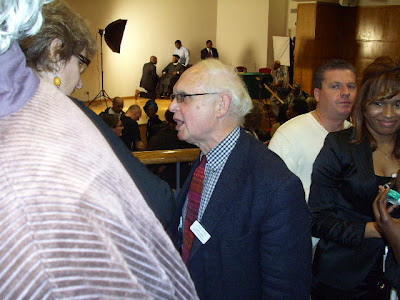
James Currey, seen here in the hubbub at SOAS ... has known Achebe since the 1960's while involved with Heinemann and the Africa Witer's Series publications.
WHY HAS THE STORY TRAVELLED IN SUCH A REMARKABLE WAY?
Professor Gikandi, ever the inquisitor moiled and persevered.
Again the simple answer and the pause.
“I don’t know…Ask IT…”
What is it?
The story itself. The power of the narrative, the magic of storytelling, the listener who was now the driver of his books and what else?
We heard more funny tales, like the audience in Korea who loved the novel’s main protagonist…charging that he Achebe “should not have killed Okonkwo the hero…”
Or of the Igbo people (for who the story is based on) who always wonder WHERE the story was actually based.
After more revelations it was time for us the audience to become inquisitors.

Dr. Ide Corley from the National University of Ireland chats with Dr. Mpalive-Hangson Msiska of University of Birkbeck. This was proper network event for sure.
WHEN YOU WRITE DO YOU THINK IN IGBO OR ENGLISH?
The issue of languages for non- English writers writing in English will always be something. He told the tale in English. He is now translating the novel into Igbo. Like Ngugi has done with some of his books.
Still on the issue of language…I wanted an elaboration on the story I read years ago about Achebe meeting the great Kiswahili writer Shaaban Robert ….a while before he died in 1962. Although Professor Achebe knew and respected the legend he had not read his works because they were all in Kiswahili.
Achebe admitted it is a tough issue. The answer is not easy. And to this day Shaaban Robert whose colossal work has earned him father of Kiswahili, has not been thoroughly translated; perhaps a few of his poems, but not much.

Aisha, Kiswahili Ph.D student at SOAS.
As for African politics today.
Are Achebe’s essays The Trouble with Nigeria (published in the 1983)still valid today?
Yes, Achebe responded.
The crisis of Nigeria is goes on and he and other Nigerians are still concerned.
I wanted to know how he writes.
DOES HE USE A LAPTOP?

NO, he said.
He writes by pen. Likes feeling his writing, physically.
I was reminded of Ernest Hemingway who said he writes standing up because he regards writing as a physical job just any other be it carpentry, farming, etc.
Yes, writing is work.

Professor Lynn Innes, who put the whole thing together...

With Kenyan writer, Ronald Wanda.
+talks+to+Louisa+and+unidentified.JPG)
Independent jornalist Christina Okoli back to camera, left, and Louisa chat to unidentified participant after the event.

With writers Kadija George, Segun Lee French, Raimi Gbadamosi

They all came to see him.
At first he was perched by the door in a wheelchair. He was photographed, greeted, touched, stared at like something special, rare.

A fan seem not to want to miss any thing the great novelist was saying...
His family was present too. In fact his grandson took a photo with him on stage afterwards.

Authors make us curious.
We read them, travelling with their tales to places we never knew. To see them in flesh is always a surprise: they might be complete turn offs; could be timid, unappealing, charming, whatever; but they are still fascinating especially if we adore them like the huge crowd at SOAS last weekend.

Yes.
People came from every corner of the world; ranging from academicians, students, writers, your average lover of books and multi-media people like Peter Kayode Adegbie Nigerian born camera man from New Castle.
Many talks and discussions and even music had been held for two days (10th and 11th October) and to finalise the epic, Simon Kigandi who in his own right is an expert on Achebe became his inquisitor, prodding and digging:
WHAT MADE YOU WRITE THINGS FALL APART?
“I don’t know.”
Chinua Achebe was as succinct and as simple as his books.

On stage the two men; like father and son; author and critic, Achebe and Kenyan scholar Professor Simon Gikandi from Princeton University exchange good hearted blows, for our benefit...
After the long laughter (and I tell you the one hour plus inquisition was plastered with loads and loads of guffaws)…. and the pause…. of a man nearing 80 years (His son Ike almost proud to tell me); with a patience that is as noble as the one I saw in Nelson Mandela when he just strolled out of prison, he enchanted us. When do you get to hear the elderly speaking? Do we listen to our elders anymore? Don’t we call them pensioners, the Boring Elders?
“I was young…everything was possible. I had to tell this story. I began to listen to my father’s friends…then I listened to the women…their folk tales were very interesting than the men’s…both men and women were interesting but the folk tales of the women were more fascinating.”

Now if you want to be a writer and you are listening to an octogenarian talking you don’t need a better ocassion. We had began to chuckle and giggle from the jokes of the Inquisitor thinking he was funny, but as soon as the slow talking, unassuming Professor Chinua Achebe opened his mouth, we were captured. We were in a super class listening to a master talking…. So quietly that the microphone had to be pushed closer to him.
Lesson number one. If you want to write a novel, if you want to write anything as substantial as this maestro does…learn to listen.

Louisa from Stand-up for Africa organisation She asked Achebe whether his essayspublished in 1983 were still valid today.
AND HOW WERE THE 1950’s?
The inquisitor went on.
It was a time of great change, Achebe responded; movement for independence in West Africa, led by Nnamdi Azikiwe in Nigeria then Kwame Nkrumah of Ghana. Mood of freedom …
That is history; and it was within that framework of time and place that he felt he had to tell his story. And you know what? He BELIEVED in his story.
In 1958 Things Fall Apart was published by Heinemann in London…
“I had very good reviews…but I don’t remember what the good reviews said. I do remember what one bad review though.”
Funny yet true.
Human nature, human behaviour, human condition. We remember bad things. Isn’t that another lesson; of life?
This particular critic (in the UK) had alleged that stories about the past were useless.
... If history is that “useless” how come we are in 2008 meeting at some remarkable college to discuss a remarkable topic and hear a remarkable man in a wheel chair talking about a novel written half a century ago?
Since then the book has been read everywhere and translated into at least 40 languages world wide.

James Currey, seen here in the hubbub at SOAS ... has known Achebe since the 1960's while involved with Heinemann and the Africa Witer's Series publications.
WHY HAS THE STORY TRAVELLED IN SUCH A REMARKABLE WAY?
Professor Gikandi, ever the inquisitor moiled and persevered.
Again the simple answer and the pause.
“I don’t know…Ask IT…”
What is it?
The story itself. The power of the narrative, the magic of storytelling, the listener who was now the driver of his books and what else?
We heard more funny tales, like the audience in Korea who loved the novel’s main protagonist…charging that he Achebe “should not have killed Okonkwo the hero…”
Or of the Igbo people (for who the story is based on) who always wonder WHERE the story was actually based.
After more revelations it was time for us the audience to become inquisitors.

Dr. Ide Corley from the National University of Ireland chats with Dr. Mpalive-Hangson Msiska of University of Birkbeck. This was proper network event for sure.
WHEN YOU WRITE DO YOU THINK IN IGBO OR ENGLISH?
The issue of languages for non- English writers writing in English will always be something. He told the tale in English. He is now translating the novel into Igbo. Like Ngugi has done with some of his books.
Still on the issue of language…I wanted an elaboration on the story I read years ago about Achebe meeting the great Kiswahili writer Shaaban Robert ….a while before he died in 1962. Although Professor Achebe knew and respected the legend he had not read his works because they were all in Kiswahili.
Achebe admitted it is a tough issue. The answer is not easy. And to this day Shaaban Robert whose colossal work has earned him father of Kiswahili, has not been thoroughly translated; perhaps a few of his poems, but not much.

Aisha, Kiswahili Ph.D student at SOAS.
As for African politics today.
Are Achebe’s essays The Trouble with Nigeria (published in the 1983)still valid today?
Yes, Achebe responded.
The crisis of Nigeria is goes on and he and other Nigerians are still concerned.
I wanted to know how he writes.
DOES HE USE A LAPTOP?

NO, he said.
He writes by pen. Likes feeling his writing, physically.
I was reminded of Ernest Hemingway who said he writes standing up because he regards writing as a physical job just any other be it carpentry, farming, etc.
Yes, writing is work.

Professor Lynn Innes, who put the whole thing together...

With Kenyan writer, Ronald Wanda.
+talks+to+Louisa+and+unidentified.JPG)
Independent jornalist Christina Okoli back to camera, left, and Louisa chat to unidentified participant after the event.

With writers Kadija George, Segun Lee French, Raimi Gbadamosi
Wednesday, 13 August 2008
SABLE LIT-MAG : site of the week
This is my favourite site of the week.
It is singing music for writers.
Writers are the library of human society. They keep our records.
Through songs, plays, films, media, stories and stirrings, they pen down words, moods and feelings.
Check out this exciting magazine published by London's award winning lady, Kadija George.
It is called Sable Lit Magazine...
www.myspace.com/sablelitmag
It is singing music for writers.
Writers are the library of human society. They keep our records.
Through songs, plays, films, media, stories and stirrings, they pen down words, moods and feelings.
Check out this exciting magazine published by London's award winning lady, Kadija George.
It is called Sable Lit Magazine...
www.myspace.com/sablelitmag
Wednesday, 21 November 2007
Latest: Nkwazi's Thought Provoking Blog
Mhhh...
An interesting writer with alot to say about present African society.
I have just been reading his blog and find it extremely thoughtful and interesting. Ideas, views, thoughts and nail biting political analysis. Nkwazi Nkuzi Mhango calls his blog Free Thinking.

Some of you might have read his articles in This Day.
Check him out. You might learn a thing or two.
My favourite take on this guy's work is the balance between good language and catchy content.
An interesting writer with alot to say about present African society.
I have just been reading his blog and find it extremely thoughtful and interesting. Ideas, views, thoughts and nail biting political analysis. Nkwazi Nkuzi Mhango calls his blog Free Thinking.

Some of you might have read his articles in This Day.
Check him out. You might learn a thing or two.
My favourite take on this guy's work is the balance between good language and catchy content.
Saturday, 29 September 2007
This Weekend's Profile: Meet WRITER URSULA TROCHE
CONVERSATION with Ursula; Cheerful Poet/Writer of Consciousness

When Ursula Troche was only six years old growing in Löhne, a small German town she used to be upset by the way fellow school mates mistreated a young Turkish girl. They teased, bullied, called her names and did horrific things to her, but at that time Ursula did not understand what racial discrimination was. “I just felt emotional about it…” That crucial experience was the beginning Journey of Discovery and Human Awareness for this London based exuberant writer, photographer and singer who starts her PhD degree this season.

As I photograph her at north London’s beautiful Clissold Park, she is constantly referring to her Trinity philosophy. She always sees people in connection with each other. In her recent self published poems (“Embraceable”) she has a picture taken in Slovakia where the railway station designs reminds her of African painting. Being of Polish, Puerto Rican and German origins, she always sees things in that cultural tripod mix. As she talks and recites her new poem on Nelson Mandela's visit to unveil his statue in London, I realise that the world needs more individuals like this. Ursula is one of the most cheerful, carefree, optimistic ladies I have ever known, who no matter what, rarely moans about the weather, or goes into a self-pitiful trips and insists that “she prefers dealing with the good rather than the pain in us…”
Here follows our chat.
FM- I am going to start with a very taboo question. Many Germans I have met abroad are ashamed of the country’s horrible Nazi past, subtly embarrassed to reveal their origins….
Ursula- Perhaps I should write about a poem about that. I used to have a friend from Ghana who used to say many Africans are constantly trying to get rid of their accents here in Europe. It is not just Africans and Germans. In the days the Irish used to be called dogs here in England their accent was teased. Everyone has hang-ups. This is one of humanity’s major problems..JPG)
FM-Your writing is very honest and straightforward. No gimmicks…
Ursula – Writing honestly and straight to the point is almost a kind of survival technique. The system we live in is often so suffocating that the only real and lasting liberation one – or at least I – can find is by discussing all the subjects that the system neglects or distorts. I want to make space for and give opportunity for liberation.
FM-“Embraceable” has no ISBN number. Are you rebelling? It is such beautiful work
Ursula – I wish ‘Embraceable’ had an ISBN number. When I put it together, I found it too much hassle to get one. I should really do it, get it reprinted or, ideally, find a publisher for it.
FM-Most poets and authors start writing early. You seem to have begun late; after living in London for seven years.
Ursula- I had only really started in 1998 because in the previous year, I had finished my degree in Politics and African Studies. It was a conservative experience actually and while writing my essays I had to resist that. Then when the degree was over, I sort of continued my resistance with poetry. A motto then and now for me was ‘I write what I like’ (Steve Biko).

FM-There are 23 poems with certain re-occurring themes.
Dance, People, Race and Culture, Being female, Freedom and Responsibility.
Are these your major concepts?
You don't dwell on the usual predictable topics of young active women : personal love, feminist politics, etc. Are you above that?
Ursula- Yes, the themes in my booklet are definitely my typical themes because these are the themes that move me, upset me, inspire me: these are the themes I live with. If these are not the usual topics one would expect of a woman like me it’s because I don’t want to repeat what’s already been said or written about. Further I am looking for more depth and engagement when discussing what happens in society. So I have this urge to speak out in the way I do because sometimes it feels like nobody else does. I’ve been involved in debates around identity and all the things you’ve mentioned because it just sort of happens to me that way because these are my experiences.
My main concerns in life are to do my contribution to re-establish an equilibrium (i.e. equality) in society that has been missing for so many centuries. And many of us are suffering from the absence of this equilibrium. Here I want to show in particular how everybody can and should get active, how I as a white person and a foreigner relate to and engage with issues to do with race relations and why understanding, dialogue and some kind of Afro-centricity is necessary for untainted life.
FM-Are you a writer by choice or by accident?
Ursula- I am definitely a writer by choice. I may have started off ‘accidentally’ but I feel that, as I approach deeper levels of liberation and more urgent longings for a revolution, I will continue. Also I think that doing this sort of thing is the way I can contribute to the overall struggle for liberation, for humanity and harmony. This is my contribution and ever since I have enjoyed the discussions and friends I have made as a result of practising my approach.
FM-You have created and raised crucial historical issues in the “Overstayer-Without a Viza” poem.
“I sometimes think that of all the African peoples
To reach Europe
It must have been the Yorubas who arrived first
Because the words Yoruba and Europe sound so alike …”
You claim the word Europe comes from the Nigerian tribe word “Yoruba…” Where did you get this argument?
Ursula- Europe =Yoruba: whether it comes from my head or creativity? When I write I seem to be really inspired, so thoughts definitely come from a place beyond me but I pick them up and put them to paper. I am fully aware that these are unusual and unexpected issues, especially coming from somebody like me, but this is just why I find it so important: 1. to get people together, 2. to get them thinking along different lines, 3. to dismantle the hegemony of distorted thinking that is the cause of divisions and inequality.
FM-You say in your blurb that you do research on what you write. Which of the poems was researched in this collection?
Ursula-The poems weren’t researched as such. But my research is on the same topics. Beyond engaging with and initiating innovative debates, I also deal with the issues academically because I don’t want to miss opportunities to dismantle that hegemony of distorted thinking, as I had put it.
But before any research, all the issues I discuss just ‘come out of me’, simply because they are so important.

FM-You also sing, paint and do photography. Which is more important?
Ursula – I haven’t painted for long although I like it a lot and will come back to it when I have more time. Singing is something I’d like to do more. I do sing my poetry, so I have a partial outlet there. Photography is probably what I mostly do these days apart from poetry, because I like to catch the beauty of nature, the rhythms and harmonies of natural life.
FM-How many copies did you publish and how can readers get hold of this book?
Ursula– For a start I have only had 500 copies printed. I should start putting them into shops, because at the moment I am just distributing them myself. So I could be contacted. But let’s talk about it, I could leave some at Centre prise Bookshop in good old Dalston (East London) for example. Further poetry-collections are also planned.
Contact Ursula for readings or speaking engagements :
ursulatroche@yahoo.co.uk.
And if you are more curious about Ursula's writing please read here.
Read another recent Profile.

When Ursula Troche was only six years old growing in Löhne, a small German town she used to be upset by the way fellow school mates mistreated a young Turkish girl. They teased, bullied, called her names and did horrific things to her, but at that time Ursula did not understand what racial discrimination was. “I just felt emotional about it…” That crucial experience was the beginning Journey of Discovery and Human Awareness for this London based exuberant writer, photographer and singer who starts her PhD degree this season.

As I photograph her at north London’s beautiful Clissold Park, she is constantly referring to her Trinity philosophy. She always sees people in connection with each other. In her recent self published poems (“Embraceable”) she has a picture taken in Slovakia where the railway station designs reminds her of African painting. Being of Polish, Puerto Rican and German origins, she always sees things in that cultural tripod mix. As she talks and recites her new poem on Nelson Mandela's visit to unveil his statue in London, I realise that the world needs more individuals like this. Ursula is one of the most cheerful, carefree, optimistic ladies I have ever known, who no matter what, rarely moans about the weather, or goes into a self-pitiful trips and insists that “she prefers dealing with the good rather than the pain in us…”
Here follows our chat.
FM- I am going to start with a very taboo question. Many Germans I have met abroad are ashamed of the country’s horrible Nazi past, subtly embarrassed to reveal their origins….
Ursula- Perhaps I should write about a poem about that. I used to have a friend from Ghana who used to say many Africans are constantly trying to get rid of their accents here in Europe. It is not just Africans and Germans. In the days the Irish used to be called dogs here in England their accent was teased. Everyone has hang-ups. This is one of humanity’s major problems.
.JPG)
FM-Your writing is very honest and straightforward. No gimmicks…
Ursula – Writing honestly and straight to the point is almost a kind of survival technique. The system we live in is often so suffocating that the only real and lasting liberation one – or at least I – can find is by discussing all the subjects that the system neglects or distorts. I want to make space for and give opportunity for liberation.
FM-“Embraceable” has no ISBN number. Are you rebelling? It is such beautiful work
Ursula – I wish ‘Embraceable’ had an ISBN number. When I put it together, I found it too much hassle to get one. I should really do it, get it reprinted or, ideally, find a publisher for it.
FM-Most poets and authors start writing early. You seem to have begun late; after living in London for seven years.
Ursula- I had only really started in 1998 because in the previous year, I had finished my degree in Politics and African Studies. It was a conservative experience actually and while writing my essays I had to resist that. Then when the degree was over, I sort of continued my resistance with poetry. A motto then and now for me was ‘I write what I like’ (Steve Biko).

FM-There are 23 poems with certain re-occurring themes.
Dance, People, Race and Culture, Being female, Freedom and Responsibility.
Are these your major concepts?
You don't dwell on the usual predictable topics of young active women : personal love, feminist politics, etc. Are you above that?
Ursula- Yes, the themes in my booklet are definitely my typical themes because these are the themes that move me, upset me, inspire me: these are the themes I live with. If these are not the usual topics one would expect of a woman like me it’s because I don’t want to repeat what’s already been said or written about. Further I am looking for more depth and engagement when discussing what happens in society. So I have this urge to speak out in the way I do because sometimes it feels like nobody else does. I’ve been involved in debates around identity and all the things you’ve mentioned because it just sort of happens to me that way because these are my experiences.
My main concerns in life are to do my contribution to re-establish an equilibrium (i.e. equality) in society that has been missing for so many centuries. And many of us are suffering from the absence of this equilibrium. Here I want to show in particular how everybody can and should get active, how I as a white person and a foreigner relate to and engage with issues to do with race relations and why understanding, dialogue and some kind of Afro-centricity is necessary for untainted life.
FM-Are you a writer by choice or by accident?
Ursula- I am definitely a writer by choice. I may have started off ‘accidentally’ but I feel that, as I approach deeper levels of liberation and more urgent longings for a revolution, I will continue. Also I think that doing this sort of thing is the way I can contribute to the overall struggle for liberation, for humanity and harmony. This is my contribution and ever since I have enjoyed the discussions and friends I have made as a result of practising my approach.

FM-You have created and raised crucial historical issues in the “Overstayer-Without a Viza” poem.
“I sometimes think that of all the African peoples
To reach Europe
It must have been the Yorubas who arrived first
Because the words Yoruba and Europe sound so alike …”
You claim the word Europe comes from the Nigerian tribe word “Yoruba…” Where did you get this argument?
Ursula- Europe =Yoruba: whether it comes from my head or creativity? When I write I seem to be really inspired, so thoughts definitely come from a place beyond me but I pick them up and put them to paper. I am fully aware that these are unusual and unexpected issues, especially coming from somebody like me, but this is just why I find it so important: 1. to get people together, 2. to get them thinking along different lines, 3. to dismantle the hegemony of distorted thinking that is the cause of divisions and inequality.
FM-You say in your blurb that you do research on what you write. Which of the poems was researched in this collection?
Ursula-The poems weren’t researched as such. But my research is on the same topics. Beyond engaging with and initiating innovative debates, I also deal with the issues academically because I don’t want to miss opportunities to dismantle that hegemony of distorted thinking, as I had put it.
But before any research, all the issues I discuss just ‘come out of me’, simply because they are so important.

FM-You also sing, paint and do photography. Which is more important?
Ursula – I haven’t painted for long although I like it a lot and will come back to it when I have more time. Singing is something I’d like to do more. I do sing my poetry, so I have a partial outlet there. Photography is probably what I mostly do these days apart from poetry, because I like to catch the beauty of nature, the rhythms and harmonies of natural life.
FM-How many copies did you publish and how can readers get hold of this book?
Ursula– For a start I have only had 500 copies printed. I should start putting them into shops, because at the moment I am just distributing them myself. So I could be contacted. But let’s talk about it, I could leave some at Centre prise Bookshop in good old Dalston (East London) for example. Further poetry-collections are also planned.
Contact Ursula for readings or speaking engagements :
ursulatroche@yahoo.co.uk.
And if you are more curious about Ursula's writing please read here.
Read another recent Profile.
Friday, 21 September 2007
MY YEAR'S FAVOURITE FILM : BABEL...
Written by Guillermo Arriaga
Directed by Alejandro Gonzalez Inarritu. Both guys did Amor Es Perros (2000) and 21 Grams (2003).
Producers : John Kilik and Steve Golin. Year 2006.
“Babel” means bedlam which is “confusion” or “total madness” in Spanish.
For me it is the best portrayal of contrasts in a film; from extreme poverty to extreme richness plus has a Hollywood mega star, Brad Pritt.
Let me start by saying I am shocked by the bad reviews Babel received. I am not going to cite them for that will highlight their content. My intention is not to review other reviewers but celebrate something that I think is underrated and quite beautiful.
Directed by Alejandro Gonzalez Inarritu. Both guys did Amor Es Perros (2000) and 21 Grams (2003).
Producers : John Kilik and Steve Golin. Year 2006.
“Babel” means bedlam which is “confusion” or “total madness” in Spanish.
For me it is the best portrayal of contrasts in a film; from extreme poverty to extreme richness plus has a Hollywood mega star, Brad Pritt.
Let me start by saying I am shocked by the bad reviews Babel received. I am not going to cite them for that will highlight their content. My intention is not to review other reviewers but celebrate something that I think is underrated and quite beautiful.
Sunday, 9 September 2007
Why Blogging Is Important to Us All...
WE want to shine "light on places and people other media always ignore.."
What a quote.
It comes from a non profit organisation called Global Voices and you know what? I met it's co-editor last Friday afternoon.

The lunch was fantastic. The talk was great. The ocassion... beautiful. So many adjectives.... because it was about blogging and writing.
After a one hour chat, it was camera time. Yes the visitor to London was none other than GV co-Editor, Solana Larsen, third left. To share the moment was Paula Góes, Brazilian blogger / GV Portuguese translator (second left) and Saidi Yakubu, BBC-Swahili London broadcaster and blogger from Tanzania, first right. Recognise the guy with red pants and a grin?
Global Voices is based in the legendary Harvard Law School at the Berkman Center for Internet and Society, USA.

Saidi, shares food and talk with Paula and Solana. All three run some active blogs and are keen to make Global Voices' crucial, monumental work succeed.
What a quote.
It comes from a non profit organisation called Global Voices and you know what? I met it's co-editor last Friday afternoon.

The lunch was fantastic. The talk was great. The ocassion... beautiful. So many adjectives.... because it was about blogging and writing.
After a one hour chat, it was camera time. Yes the visitor to London was none other than GV co-Editor, Solana Larsen, third left. To share the moment was Paula Góes, Brazilian blogger / GV Portuguese translator (second left) and Saidi Yakubu, BBC-Swahili London broadcaster and blogger from Tanzania, first right. Recognise the guy with red pants and a grin?
Global Voices is based in the legendary Harvard Law School at the Berkman Center for Internet and Society, USA.

Saidi, shares food and talk with Paula and Solana. All three run some active blogs and are keen to make Global Voices' crucial, monumental work succeed.
Subscribe to:
Posts (Atom)