Showing posts with label History. Show all posts

Friday, 17 June 2016

BOXER MUHAMMAD ALI'S LEGACY IS STRONGLY FELT IN AFRICA

When I was still in secondary school boxer Muhammad Ali was a big hero in Africa. In 1974 he fought George Foreman in Kinshasa, Congo DRC. That was gigantic and explosive. WE stayed all night to listen to the duel on the radio as there was no TV in Tanzania those days. Ali inspired us so much in his pride, athleticism, political awareness, poetry, liberation and so on. 
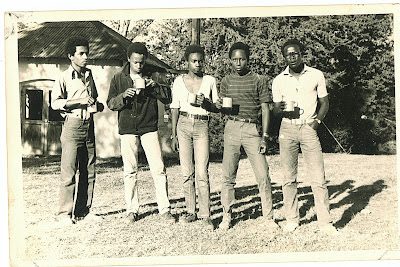
Youth and Fitness. At Mzumbe Secondary School we had a boxing team galvanized  100%  by Ali. From left with a fist salute, is the late Professor Chachage S Chachage- died in 2006. Second with hat is author. Third is the late Hussein Laiser, died in 1994. The rest, Msuya and our coach at the back  with arms folded, John Kihampa, I have failed to trace ever since.

Ali visiting Tanzania in 1980. Big event. Pic by legendary photographer Vincent Urio.

 During that year, Reggae star, Bob Marley also visited Africa and played at Zimbabwe independence rally in Harare. Musician James Brown likewise, came to Africa. Those were great links between African Americans and Africa....In the same year, 1980,  legendary Guyanese historian Professor Walter Rodney who had lived in Tanzania teaching history was assassinated in his homeland.
Compare this with what boxer Floyd "Money" Mayweather said about Africa in May 2015. That Africa has done nothing for him so he does not what? READ THIS.


Monday, 13 October 2008

NIGERIAN WRITER : CHINUA ACHEBE IN LONDON OCT 2008

UMUOFIA KWENU !

They all came to see him.
At first he was perched by the door in a wheelchair. He was photographed, greeted, touched, stared at like something special, rare.

A fan seem not to want to miss any thing the great novelist was saying...

His family was present too. In fact his grandson took a photo with him on stage afterwards.

Authors make us curious.
We read them, travelling with their tales to places we never knew. To see them in flesh is always a surprise: they might be complete turn offs; could be timid, unappealing, charming, whatever; but they are still fascinating especially if we adore them like the huge crowd at SOAS last weekend.

Yes.
People came from every corner of the world; ranging from academicians, students, writers, your average lover of books and multi-media people like Peter Kayode Adegbie Nigerian born camera man from New Castle.
Many talks and discussions and even music had been held for two days (10th and 11th October) and to finalise the epic, Simon Kigandi who in his own right is an expert on Achebe became his inquisitor, prodding and digging:
WHAT MADE YOU WRITE THINGS FALL APART?
“I don’t know.”
Chinua Achebe was as succinct and as simple as his books.


On stage the two men; like father and son; author and critic, Achebe and Kenyan scholar Professor Simon Gikandi from Princeton University exchange good hearted blows, for our benefit...
After the long laughter (and I tell you the one hour plus inquisition was plastered with loads and loads of guffaws)…. and the pause…. of a man nearing 80 years (His son Ike almost proud to tell me); with a patience that is as noble as the one I saw in Nelson Mandela when he just strolled out of prison, he enchanted us. When do you get to hear the elderly speaking? Do we listen to our elders anymore? Don’t we call them pensioners, the Boring Elders?
“I was young…everything was possible. I had to tell this story. I began to listen to my father’s friends…then I listened to the women…their folk tales were very interesting than the men’s…both men and women were interesting but the folk tales of the women were more fascinating.”


Now if you want to be a writer and you are listening to an octogenarian talking you don’t need a better ocassion. We had began to chuckle and giggle from the jokes of the Inquisitor thinking he was funny, but as soon as the slow talking, unassuming Professor Chinua Achebe opened his mouth, we were captured. We were in a super class listening to a master talking…. So quietly that the microphone had to be pushed closer to him.
Lesson number one. If you want to write a novel, if you want to write anything as substantial as this maestro does…learn to listen.

Louisa from Stand-up for Africa organisation She asked Achebe whether his essayspublished in 1983 were still valid today.

AND HOW WERE THE 1950’s?
The inquisitor went on.
It was a time of great change, Achebe responded; movement for independence in West Africa, led by Nnamdi Azikiwe in Nigeria then Kwame Nkrumah of Ghana. Mood of freedom …
That is history; and it was within that framework of time and place that he felt he had to tell his story. And you know what? He BELIEVED in his story.
In 1958 Things Fall Apart was published by Heinemann in London…
“I had very good reviews…but I don’t remember what the good reviews said. I do remember what one bad review though.”
Funny yet true.
Human nature, human behaviour, human condition. We remember bad things. Isn’t that another lesson; of life?
This particular critic (in the UK) had alleged that stories about the past were useless.
... If history is that “useless” how come we are in 2008 meeting at some remarkable college to discuss a remarkable topic and hear a remarkable man in a wheel chair talking about a novel written half a century ago?
Since then the book has been read everywhere and translated into at least 40 languages world wide.
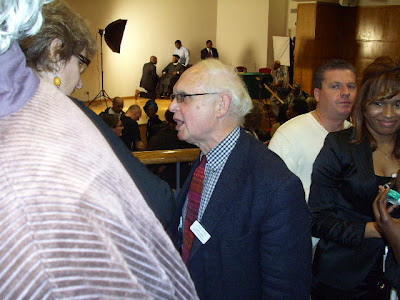

James Currey, seen here in the hubbub at SOAS ... has known Achebe since the 1960's while involved with Heinemann and the Africa Witer's Series publications.

WHY HAS THE STORY TRAVELLED IN SUCH A REMARKABLE WAY?
Professor Gikandi, ever the inquisitor moiled and persevered.
Again the simple answer and the pause.
“I don’t know…Ask IT…”
What is it?
The story itself. The power of the narrative, the magic of storytelling, the listener who was now the driver of his books and what else?
We heard more funny tales, like the audience in Korea who loved the novel’s main protagonist…charging that he Achebe “should not have killed Okonkwo the hero…”
Or of the Igbo people (for who the story is based on) who always wonder WHERE the story was actually based.
After more revelations it was time for us the audience to become inquisitors.


Dr. Ide Corley from the National University of Ireland chats with Dr. Mpalive-Hangson Msiska of University of Birkbeck. This was proper network event for sure.

WHEN YOU WRITE DO YOU THINK IN IGBO OR ENGLISH?
The issue of languages for non- English writers writing in English will always be something. He told the tale in English. He is now translating the novel into Igbo. Like Ngugi has done with some of his books.
Still on the issue of language…I wanted an elaboration on the story I read years ago about Achebe meeting the great Kiswahili writer Shaaban Robert ….a while before he died in 1962. Although Professor Achebe knew and respected the legend he had not read his works because they were all in Kiswahili.
Achebe admitted it is a tough issue. The answer is not easy. And to this day Shaaban Robert whose colossal work has earned him father of Kiswahili, has not been thoroughly translated; perhaps a few of his poems, but not much.

Aisha, Kiswahili Ph.D student at SOAS.

As for African politics today.
Are Achebe’s essays The Trouble with Nigeria (published in the 1983)still valid today?
Yes, Achebe responded.
The crisis of Nigeria is goes on and he and other Nigerians are still concerned.
I wanted to know how he writes.
DOES HE USE A LAPTOP?

NO, he said.
He writes by pen. Likes feeling his writing, physically.

I was reminded of Ernest Hemingway who said he writes standing up because he regards writing as a physical job just any other be it carpentry, farming, etc.
Yes, writing is work.

Professor Lynn Innes, who put the whole thing together...


With Kenyan writer, Ronald Wanda.


Independent jornalist Christina Okoli back to camera, left, and Louisa chat to unidentified participant after the event.


With writers Kadija George, Segun Lee French, Raimi Gbadamosi

Tuesday, 4 March 2008

A NEWLY LAUNCHED WEBSITE...

Interested in history, in cities, in people, immigration, in origins?
Check out a newly launched website by a hardworking London teacher.
He says:
"...I would really appreciate it if you could encourage people who haven’t been on an east end walk to come along for the first time. Please forward the website address to them. I have some promotional leaflets about the walks at the printers and would be grateful for good suggestions of places to leave them. Hope you enjoy the website.

Wednesday, 5 September 2007

Olodum from Bahia, Brazil.


You know what?

One of the most famous percussion bands in the world, if not the most known, is Olodum from Bahia, Brasil. At the time this photo was taken in 1992, in Liverpool, England; Olodum would perform with over thirty percussionists. It was after American musician Paul Simon released the album “Rhythm of the Saints” which had a mesmerising tune played by Olodum, “Obvious Child.” Before that Olodum was mostly known in Brasil but this record introduced them to the rest of the world. Today, they are an institution.

Sunday, 26 August 2007

...BEFORE MANDELA THERE WAS MWALIMU NYERERE

A PHOTO FROM THE PAST
Nyerere in Rio De Janeiro, Brazil, June 1991...
Mwalimu Nyerere flanked by assistants, officials and bodyguards asking Freddy Macha about  life in Brazil. Pic by Vantoen Perreira...

When we speak of great Africans and role models, an image of a smiling Nelson Mandela with those troubled but noble, yet kind shining eyes, comes to mind. Nelson Mandela is the chap that everyone wants to take a photo with. Twenty six years in jail for sticking his tongue at racial hatred, then stepping out of jail, waving a hand, smiling, saluting the world, forgiving…
Before Nelson Mandela there was Julius Kambarage Nyerere.
But who is Nyerere?
Many do not recognise the name. Known in his time as "Mwalimu", which means teacher in Swahili, Nyerere was born in 1922 and while still at Makerere University, Uganda, at the tender age of 21, started an association for the improvement of Africans. Those were colonial days. Two years passed. He wrote an essay: “The Freedom of Women.”
His father, a tribal chief, had 22 wives. It was part of the “idea of moving towards freedom theoretically,” he told Dr. Ikaweba Bunting of the Internationalist magazine in one of his last major interviews in 1999.
On July 7th, 1954, Mwalimu Nyerere formed TANU which led Tanzania to independence. Here the idea of using Swahili as a unifying language was hatched and fundamental in keeping the peace as there are more than hundred tribes and languages in Tanzania. “The only tribalism that exists in Tanzania is teasing each other.” Nyerere would say in one of his speeches, decades later. Between all this he found time to translate two works of William Shakespeare (Julius Caesar and Merchants of Venice) to Swahili.


Sunday, 12 August 2007

A photo from the past

Everyone was a teenager once…
Ilboru Secondary School, Arusha, north Tanzania, Autumn 1972.
We are all studying hard.
Main O levels exams are around the corner. We have just done sports, showered, now we are breezing in the late evening sun with tea mugs; waiting for dinner, then prep.
Prep meant more reading, more digging, more books.
Everyone wanted to do well and pass.
Ilboru was highly regarded those days with teachers from all over the world. You couldn’t be a lazy pupil and be at this school…You had to have very excellent grades to come here.
Boarding schools are intense places. We would be there for almost five months, away from home. The bondage amongst the young is incredible.
If you look closely you will notice we are all wearing jeans the new “bad boy” trouser of the early 1970’s. We would swap into bell-bottoms when going out to dance and meet the girls…
I was in a gang. The gringos. But the word gang didn’t mean guns and knives. It meant sharing similar tastes. Music, dancing, sports, arts, hanging out. Four years of sweet youth. A few months after this photo was taken by a boy named Emmanuel, I never met these guys again. In fact almost all of them have vanished from my life. Meciri, with glasses on the right, I heard, died. Bandido the second, was shot in 1981 in very mysterious circumstances. Actually, I was with him earlier that day before his demise. I had not seen him for nine years. He was a charismatic guy and you can tell by the way he is standing; like a model. He had been abroad studying and he was doing well.
Tony, on my left, passed away, last year.
I am the shy guy peering into the tea mug. What the hell is inside that cup? A fly? I was very broody. Really into myself, my music and my writing.
I don’t know what happened to Miro (from Zanzibar) staring into the distance, standing on my right. Although the soft spoken Miro was older and a class ahead, he loved hanging out with us, juniors.
Youth is a strange time and hanging out, the ultimate good time.
And what about Emmanuel the photographer? He was the unofficial multi-talented snapper of the school. Rarely spoke, always chuckled, patient, a budding bio-chemist. Never heard of him, never saw him ever since.
And those trees, behind us. Under them was a lovely stream. I can still hear the water dripping and chirping birds, wow...singing. Arusha has one of the most lovely scenes and retains wonderful landscapes, wild game tourist reserves, lakes and mountains. Serengeti where the famous "Lion King" Hollywood film story is based is not so far away from here. Beautiful Arusha is today the most expensive region of Tanzania.

Tuesday, 31 July 2007

Starting...


hi, my name is, freddy macha.

iam not that important. The things am going to try... to tell you.... are more significant. about finding out. recalling. refurbishing.
That is one way of approaching this. strolling back and forth.
So here we go.
i love history. But i also love Now. So we shall travel fowards and backwards, since life is up and down, left to right, swinging, standing.
Past events are like parents. Without history there is no herstory, and without herstory there is no history. EVERYTHING IS CONNECTED TO SOMETHING ELSE.
So?
That recent snap was taken byJJ Otieno, a remarkable photographer and distinguished artist-musician. Anyway.
Today is 3oth July.
We are halfway thru 2007. Let us try and look at time. distance. Recall some few interesting things, so far.
On February 6th i went to check out a friendly party in west London. An amicable game. A football game. If you are in USA you are thinking soccer. If you are in the rest of the world you might have heard the friendly between Ghana and Nigeria. Amusement. Fun.

Check out these guys....


Football is not just about countries or muscular males running after a piece of rubber. Any sport brings people together and hints at all sorts of stuff. Communities. Culture. Money. Psychology. Dressing up. Style.

Nigeria versus Ghana reminded me of a match i saw in Rio De Janeiro, back in 1988. Maradona was playing. Bebeto was playing. Diego Maradona was the topical player then and i and a couple of fellas were screaming. It was also called a friendly. Eyes almost popping out of our sockets, as we witnessed the mesmerising skills of the maestro. Two years earlier Argentina had won the world cup in Mexico City. Now here we were at the most famous stadium (in the world) the Maracana. A few moments into the game we became aware of not so good looks of some Brazilian fans and quickly checked our tongues. Imagine watching the great Zinedine Zidane and keeping mum.
Maradona was pure magic.
Now that is history. Brazil versus Argentina. 1988...in Rio.
remember the theme of this piece.

History is like parents.

Rewind to Feb 6th, 2007...
There is so much apprehension; beautiful apprehension. Ghana has just been in the World Cup 2006. Nigeria are well... excellent....(1996 Winners of the World Olympics in Atlanta, for example) and players from both sides are well...legends and ... exciting. While buying the ticket, one Ghanian says Michael Essien was practising alone that morning..."a dedicated and disciplined guy, thats why he is so good."
Listen and learn.
Dedication and discipline.
Serious words.
And.
The match would be at Griffith Park, Brentford, and the duel is already been played on the net. Waw! Fan emails from both sides were as exciting as the match itself.
Listen to this:

"Nigeria should invade Ghana and build a stadium there.”

“Be sure that Nigeria will beat Ghana any day and any time, no matter where the match will be played. Even if you invite us to your bedroom, Nigeria will beat you there.”

Or:
"Nigeria fans should stop talking about old glory. Ghana is the best in Africa now. Believe it or not. Ghana will beat Nigeria."
Free T-shirts issued by Money Gram. take it, take it...
Wherever there is an African there is music, I heard someone saying that day. I do recall glorious faces of men, children, women, families , dancing. BBQ. Booze.
Long queque to the toilets, chants, chatting...
screaming, clapping...

No goals in the first half, though. Popular culture is not just about goals. It is about people!

People need People!


When Stephen Appiah (Ghana’s captain) and Shilla Illiasu ( no. 7) missed goals the angry taunts began. It got worse when Chelsea’s Michael Essien (most expen$ive player in African football history) was injured. Accusations of softness vibrated.
“CELEBRITY!”
“£90,000, A WEEK!”
In the second half Ghana netted four goals and the insults turned to celebration; but Nigeria’s brilliant skipper Nwankwo Kanu was not spared. As he warmed up to get in five minutes before the end, he was booed by Ghanaian fans. The verbal harassment reminded me of that Maradona incident I told you earlier. Here is the most highly decorated African player (ten awards minimum) and one of the top goal scorers in the English league, being belittled just for being on the Other Side.
Like said, this was a friendly.

There were many other friendlies that day. They were all in the media. Portugal versus Brazil at Arsenal's stadium. England versus...do you remember?Of course it was headline news. Spain.

And the most important thing? It happened. It was memorable, it was enjoyable.
In the beginning of 2008 we have Africa Cup Championships...

We will be back in July 2008 and ask the eyes. They are our police.